Average Reviews:

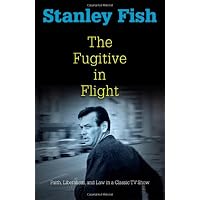
(More customer reviews)If you're a hardcore FUGITIVE fan looking for an episode-by-episode guide to that fondly-remembered '60s show, look elsewhere...'cause this ain't it! For one thing, the sub-title of Stanley Fish's THE FUGITIVE IN FLIGHT is FAITH, LIBERALISM AND LAW IN A CLASSIC TV SHOW; does that tell you something? Secondly, Fish is a Humanities and Law professor at UI-Chicago and college profs tend to produce scholarly, analytical treatises rather than popular histories. Having said that, THE FUGITIVE IN FLIGHT is an interesting take on David Janssen, Barry Morse & Company.
THE FUGITIVE series was unique in several aspects. Because of the 'fugitive-on-the-run' theme, the show always has an underlying tension missing from other, contemporary shows. Just as importantly, the main character - Richard Kimble - never changed during the course of the show. He was a change agent but he himself never changed, never evolved. He came into some situation wherein others needed to change. He helped them and moved on. Lastly, the show existed in a social vacuum, Kimble's adventures taking no heed of the momentous events going on in real-life America. His quest to redeem his name and reputation by finding the one-armed man who killed his wife while avoiding his relentless pursuer, Lt. Gerard, was the center of an alternative world bereft of battles over civil rights, the escalating Vietnam War, etc.
Fish's text therefore concerns itself with the series' moral structure, issues of law, freedom, evidence, liberalism, belief/faith, judgement, etc. rather behind-the-scenes details of the show, the actors, etc. He does examine various episodes but only to show how they mirrored the world view fashioned by Roy Huggins, its creator, and his writing staff.
I'm not sure THE FUGITIVE IN FLIGHT will appeal to all FUGITIVE fans. Fish labels Kimble "basically a dull person" at one point! Yet I enjoyed reading it. Fish's comments were thought-provoking although sometimes pretty dry. It's certainly worth a look-see. Recommended.
Click Here to see more reviews about: The Fugitive in Flight: Faith, Liberalism, and Law in a Classic TV Show (Personal Takes)
"In the 1990s when I was watching reruns of The Fugitive on the Arts and Entertainment Network twice a day, I couldn't take my eyes off it. . . . No one in The Fugitive ever relaxes as you watch and you can't relax either, even though for long stretches absolutely nothing happens. It was the combination of nonstop tension with the (relative) absence of slam-bang action that attracted me, and as I now reflect on it, the same combination characterizes the literary works I have been reading and writing about for more than forty-five years."—Stanley Fish, from the IntroductionIn the stark television drama The Fugitive, Dr. Richard Kimble, an innocent man convicted of murder, is on the run from the police and in pursuit of the real killer. The award-winning show, which aired on ABC from 1963 to 1967 and inspired a 1993 blockbuster movie, still has many devoted fans, none more passionate than literary and legal theorist and intellectual provocateur Stanley Fish. In The Fugitive in Flight, Fish examines the moral structure of the long-running series and explains why he thinks this may well be the greatest show ever aired on American network television.Analyzing key episodes, The Fugitive in Flight goes beyond plot summaries and behind-the-scenes stories. For Fish, the real action of The Fugitive takes place in confined spaces where the men and women Richard Kimble encounters are forced to choose what kind of person they will be for the rest of their lives. Kimble is the catalyst of such choices and changes, but he himself never changes. Breaking free from the political and social problems of his time, he is always the bearer and exemplar of the very middle-class values informing the system that has misjudged him. Kimble is the perfect representative of a mid-twentieth-century liberalism that values above all independence, personal integrity, and the refusal to surrender oneself to obsessions or causes. He is so consistently faithful to his liberal vision of life that he displays both its virtues and its dark side, the side that flees attachments, entanglements, responsibilities, and human connections. Stanley Fish's Richard Kimble is the ultimate man in a gray flannel suit, even when he is wearing a windbreaker and walking down a dark, lonely road.
 Get 33% OFF

0 comments:
Post a Comment