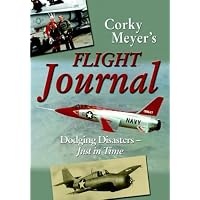
Average Reviews:

(More customer reviews)This book is a miracle. The miracle is that the author lived to write it.
'Corky' Meyer joined Grumman in the 1940s when that company was demonstrating its ability to design and build Navy fighters such as the Hellcat and Bearcat (and, later, other types of Naval aircraft and civilian flying boats), and went on to undertake flight test of essentially every significant Grumman fighter from the F-6F-3 Hellcat, the F-8F-1 Bearcat, the twin-engined F7F-1 Tigercat, the jet F-9F-2 Panther, the Navy's first swept-wing fighter--the F-9F-8 Cougar, up to the F11-F Tiger (all Grumman's fighters have been named after cats of various types). He became one of the very few, if not the only civilian pilot ever to achieve 'carquals'--carrier qualifications.
Meyer flew dozens of different aircraft from many countries, and his commentaries are illuminating, including his chapter on "the best fighters of WWII," undertaken for FLIGHT JOURNAL. His conclusions, based significantly on analysis of warfighting results, will be the subject of endless hangar flying by readers of the book.
This book charmingly, humbly but with marvelously tongue-in-cheek humor traces the author's adventures and misadventures over a long and brilliant career in flight test. He and a few dozen other civilian and military test pilots enabled the difficult, painful and often fatal transition from the relatively simple propeller-driven fighter aircraft that endured into the 1950s up to the current complex devices. Many did not survive but gave their lives to flight test, bravely, often in the most difficult circumstances imaginable.
In effect, his experience covers the transition from personal observation by the hands and the seat of the pants to the slide rule to the eventual use of sophisticated measuring systems on the aircraft that morphed eventually into computer-aided simulation and telemetry, as speeds went from subsonic to supersonic, and as materials, structures, systems and procedures placed ever-increasing demands on every aspect of aircraft development from initial design through prototyping into flight test and eventual production. Meyer was never afraid to speak his mind to those around him, sometimes insisting on changes that took a lot of time and effort to undertake but were proved right in the end. His conclusions were sometimes intuitive but were often right. When he was wrong, he said so.
This book reminds me of the similarly marvelous SPITFIRE: A Test Pilot's Story, by Jeffrey Quill (see my review), and it belongs on the bookshelf of every pilot interested in understanding whose shoulders we are truly standing on. Meyer and Quill, brothers in the cockpit, write definitively about some of the most interesting flying ever done.
The book is particularly important for pilots who are interested in naval aviation (every naval aviator will enjoy it) because it makes clear that aircraft development for carrier operation is a very difficult art. It requires not only that the basic characteristics and performance meet the specifications for a fighter aircraft but that it must also be able to withstand the rigors of carrier arrivals (22-feet-per-second descent rate at trap), acceptable approach speeds and stability that makes it suitable for average naval aviators (there is probably no such thing, especially in the eyes of naval aviators).
Problems are always more interesting to read about than cake walks, and Meyer got his fill. He saved his life, and the lives of countless others, through his ability to analyze, decide and act decisively under severe stress. His description, alone, of his flight-test experience of the variable-sweep XF10-F-1 Jaguar and its appalling difficulties (it was a significant contributor to the F-14 Tomcat, technically) is worth the price of the book, but any page you look he describes, often with profound candor, the lot of the test pilot before (and this is crucial in terms of survival) reliable ejection seats were developed.
So the miracle happened. Corky lived to write this fine book. It lacks only an index.
_________________________________________________________________
Disclaimer: early in the development of the book, Corky asked me to help with the editing. He didn't need my help. He writes as well as he flies.
Click Here to see more reviews about: Corky Meyer's Flight Journal
Designing high-performance military aircraft in the slide-rule era was challenging.Being the first person to fly these airplanes and expand an aircraft's flight envelope was often very frightening, if not downright deadly.It is hard to believe that someone could really endure 22 years in this occupation, plus another 30 years in the aircraft industry, often leading the industry-wide transition from large, too-complicated piston engines to doggy, unreliable jet engines and from 300-mile-per-hour "barn doors" through slippery transonic and supersonic airframes.But this is, in fact, the truly remarkable – if not virtually unparalleled – life story of Corky Meyer.In an occupation and time which killed many, if not most, this man had the brains, skill, and good luck to meet every challenge that faced him and survive to tell his amazing story.It is a story that covers the most important era in the history of flight, told by a man at the epicenter of the activity. Corky Meyer's Flight Journal is an electrifying tale of a very passionate and patriotic man, his wife and family, and of course his numerous sensational close calls as an experimental fighter test pilot.
 Get 24% OFF
Click here for more information about Corky Meyer's Flight Journal

0 comments:
Post a Comment