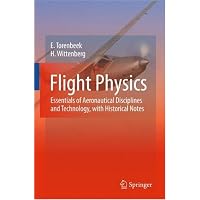
Average Reviews:

(More customer reviews)Of the available freshman texts in aerospace engineering, I think this is the best overall. The title accurately reflects the content. It covers a broad range of topics at an appropriate level but doesn't oversimplify matters, so it provides good background reading for higher-level courses too. Material appropriate to both civil and military aircraft is covered but the emphasis is more strongly on civil. A definite plus for those outside the US is that it adopts SI units throughout. A slight weakness is that there are no examples or problems.
Click Here to see more reviews about: Flight Physics: Essentials of Aeronautical Disciplines and Technology, with Historical Notes
This textbook gives an introduction, with extensive historical notes, to the principal disciplines of aeronautics. The principles of applied aerodynamics, aircraft propulsion, flight performances, stability and control of conventional subsonic aircraft are augmented by overviews of helicopter technology and high speed flight.Overviews of the history of aviation and basic aeronautical terms are followed by descriptions of the major disciplines involved in aircraft flight mechanics. These are discussed in five chapters dealing with low speed aerodynamic properties (lift and drag) of wings, aircraft engines and propulsion, performances, and stability and control of aircraft. The last two chapters deal with helicopter aerodynamics and flight mechanics, and complications of high speed (transonic and supersonic) flight.In order to keep the introductory character there is an equal amount of basic formulas and explanatory text. Although problems and their solutions are not presented, there are plenty of opportunities for lecturers to extract material for practicing and examination.
 Get 23% OFF

0 comments:
Post a Comment