Average Reviews:

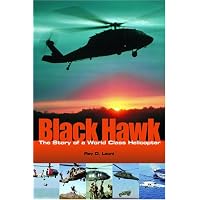
(More customer reviews)Ray Leoni's "Black Hawk: The Story of a World Class Helicopter," is the first detailed story of the development of the H-60. This ubiquitous multi-purpose helicopter, of which over 3000 have been built to date, is now serving with every branch of the US military, as well as with 24 foreign countries. Even if you have little interest in history, this book is for you. The lessons discussed here are as much about how to run a successful proposal capture effort - reshaping a company in the process - as about the particular trials and tribulations of developing a revolutionary helicopter. This is an excellent book for historian, student, designer and manager alike.
Leoni, considered by many to be the "father" of the Black Hawk, was uniquely qualified to tell the story of its development. Having started at Sikorsky in the ramp-up to the heyday of production during the late 1950s - reaching nearly 500 helicopters per year - Leoni witnessed the dismal decline in sales that bottomed out in the mid-1970s with less than one-tenth that output. When the Utility Tactical Transport Aircraft System (UTTAS) program began in January 1972, production of helicopters for the Army was dominated by Bell and Boeing Vertol. Since Sikorsky was such a small part of the Army's production base - finishing the last of 94 CH-54 Tarhe flying cranes during this time - and because Sikorsky had lost the last two major Army competitions, the odds of Sikorsky winning the UTTAS program were widely thought to be near zero. But winning was seen by Sikorsky management to be a matter of survival, despite the long odds.
Promising research and development, however, encouraged Sikorsky management to take the chance, since all of the key new technologies - titanium main rotor blades, elastomeric rotor head, bearingless composite tail rotor, and canted tail rotor - had been test flown on helicopters larger than UTTAS. After winning a chance to build their YUH-60A demonstrator, Sikorsky invested heavily in their bid and was eventually rewarded in December 1976 with the Black Hawk production program - arguably the most important contract ever won by Sikorsky.
Leoni started on the UTTAS design team in 1971, conducting concept formulation studies; he led the team whose design was selected by Sikorsky management to be their UTTAS proposal. After contract award, Leoni became the program engineering manager, responsible for all Black Hawk engineering design and test activities, and in 1976, the overall program manager. Eventually, in 1991, Leoni would retire as Sikorsky's senior vice president for engineering and advanced programs.
Leoni takes an interesting approach to introducing the story: the first chapter is a detailed overview of the book, beginning with the utility of the helicopter for rescue missions and the need for air mobility during Vietnam; it continues with the initial UTTAS design competition and company strategy, followed by the flight test competition, and the selection for initial production, and finally the many variants and derivatives of the Black Hawk. The overview itself - 18 pages in all - is an excellent summary of the entire book, and calls out each of the following chapters as "hardcopy hyperlinks" to find the full story.
The book describes in considerable technical detail the severe technical problems encountered during flight testing - vibration, speed performance, maneuverability and handling qualities - and how they were solved in time to win the production award. The full stories of raising the rotor, finding the right tail and many other design and test challenges are told here. The most memorable flight test story is that of a "fortuitous" crash landing in a pine forest - no one was injured and, after cutting the stumps down to the ground, the Army replaced the rotor blades were replaced and the aircraft was flown out! This was the first demonstration of the incredible ruggedness of the Black Hawk.
This is truly a landmark book. In writing "Black Hawk: The Story of a World Class Helicopter," Leoni has done a great service not only to the helicopter community, but to the larger aerospace community as well. He has laid out in exquisite detail not only what worked, but what didn't. Many of the timeless lessons learned outlined here are applicable across a broad spectrum of the aerospace industry. One could only hope that every aircraft development program would write a book like this!
Click Here to see more reviews about: Black Hawk: The Story of a World Class Helicopter (Library of Flight Series)
"This story tells, in clear detail, how Sikorsky Aircraft developed, tested, modified, and produced one of the most successful helicopters in the world. Written by the man considered to be the father of the Black Hawk, Ray Leoni explains how Sikorsky used innovative designs with the right advanced technologies to meet the ArmyÃs stringent specifications for aircraft performance, survivability and reliability. With its creative Black Hawk design, Sikorsky won an uphill, highly-contested battle for one of the worldÃs largest helicopter programs which reestablished the company as a leader in the world community of helicopter producers.Black Hawk variants have been put in service by every branch of the US Military and by over 24 countries around the world accumulating over 5 million flight hours. Through its combat service in the campaigns of Granada, Panama, Somalia, Afghanistan and Iraq, the Black Hawk has demonstrated unprecedented mission versatility and survivability and proven itself to be an outstanding war-fighting machine that will serve for a half century or longer. In the best tradition and vision of Igor Sikorsky, Black Hawks are performing world-wide rescue and humanitarian missions saving countless lives and providing relief from natural and manmade disasters to thousands of people across the globe.The Army program began in 1972 with the issuance of Requests for Proposals for the Utility Tactical Transport Aircraft System to the U.S. helicopter industry. Both Boeing Vertol and Sikorsky were awarded contracts to design and build prototype Black Hawks for Army side-by-side evaluation. Those awards set off an intense 4-year competition between the two companies that culminated in the final production selection in 1976. That competition focused on developing the best possible helicopter to offer for production selection by the Army following a 7-month fly off evaluation. During this critical evaluation, a night-time crash occurred of one of SikorskyÃs three prototypes with 14 Army personnel aboard. This book shows the cause and results of that crash and describes how its consequences actually strengthened SikorskyÃs competitive position. It also describes in considerable technical detail the problems encountered by Sikorsky during prototype development in vibration, speed performance, maneuverability and handling qualities and how they were solved in time for the production award. Many of the key people responsible for the success of the Black Hawk program are identified throughout this book.Readers will benefit from the unique insights into the challenges of helicopter development as well as successful management strategies presented in this book."
 Get 4% OFF

0 comments:
Post a Comment