Showing posts with label paleontology. Show all posts

How Dinosaurs Took Flight: The Fossils, the Science, What We Think We Know, and Mysteries Yet Unsolved (Outstanding Science Trade Books for Students K-12 (Awards)) Review

How Dinosaurs Took Flight: The Fossils, the Science, What We Think We Know, and Mysteries Yet Unsolved (Outstanding Science Trade Books for Students K-12 (Awards))
Average Reviews:

(More customer reviews)
This slim (64 pages) volume carries a hefty price tag, but at this point it's worth it, because there isn't a lot on the market covering the dinosaurs-with-feathers subject (so far as I know). Dr. Xu Xing, who wrote the foreward, is a notable character in the unfolding drama of feathered fossils being found in China.
I consider this book a bit radical in that it runs with the theory of dinosaurs being birds (or was it vice versa?), calling them all dinosaurs: nonavian dinosaurs for the "dinosaurs" and avian dinosaurs for the "birds." It is written in a fairly simple and straightforward manner; I think it is a YA title although I mostly bought it for myself (as a parent having just taken the kids to see the James Gurney's Dinotopia exhibit and activites at the Norman Rockwell Museum in Stockbridge MA). I think one might want to read it with a child, so that, for example, a younger reader might not end up being teased for insisting that birds are dinosaurs. The theory is out there, it's current, but it's not completely validated yet. I would like to see more well illustrated books on the subject, but this one is a great start.

Click Here to see more reviews about: How Dinosaurs Took Flight: The Fossils, the Science, What We Think We Know, and Mysteries Yet Unsolved (Outstanding Science Trade Books for Students K-12 (Awards))

How did dinosaurs get feathers? How did they start flying? What use were feathers to dinosaurs that didn't fly? Chris Sloan's 2000 book Feathered Dinosaurs introduced kids to the radical idea that some dinosaurs had feathers and that birds are, in fact, a subset of dinosaurs. In How Dinosaurs Took Flight, Sloan returns to these ancient feathered creatures to introduce kids to the fascinating new finds—including a Tyrannosaur with feathers and a dinosaur with not just two but four wings. The author focuses on the tough new questions scientists are asking right now, the evidence they've gathered, the hypotheses that are developing from the evidence, and the unknowns that remain. This book will be the most up-to-date children's book on this topic on the market.

Buy NowGet 22% OFF

Click here for more information about How Dinosaurs Took Flight: The Fossils, the Science, What We Think We Know, and Mysteries Yet Unsolved (Outstanding Science Trade Books for Students K-12 (Awards))

Dinosaurs of the Air: The Evolution and Loss of Flight in Dinosaurs and Birds Review

Dinosaurs of the Air: The Evolution and Loss of Flight in Dinosaurs and Birds
Average Reviews:

(More customer reviews)
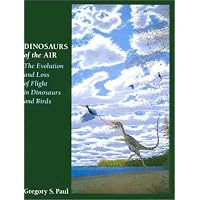
Dinosaurs of the Air: The Evolution and Loss of Flight in Dinosaurs and Birds written by Gregory S. Paul is a well detailed book on comparetive anatomy between bird and dinosaurs.
The author is a well known evolutionary scientist and dinosaur illustrator and he has some interesting things to tell about in this book. For instance, the ancestor-descendant relationship of to birds and dinosaurs, most of the conventional thinking is that dinosaurs evolved into birds, but the author believes that on occasion the rolls could be reversed. That there may be many dinosaurs that were the secondarily flightless descendants of creatures we would think as birds.
This is contraversial, but the author makes his point with in-depth analyses of bird and theropod phylogenetics. There are many line-drawings that do a comparetive analysis, wing dimensions, avian/dinosaurian metabolics... this book has very detailed information. But, the book is written so that the layperson with a little scientific knowledge will unterstand the author intent.
This book has stunning illustrations throughout and well detailed bibliography making the information found in this book believable. There is a detail appendix toward the back of the book that covers in detail things of import for the book.
If you are one of the people who has an interest in avian/dinosaurian link this is a must purchase. This is an excellent book as it combines a large amount of technical data with drawings and related bird origins, including the energetics of the origin of avian flight. But, even with this detail, it is highly readable.

Click Here to see more reviews about: Dinosaurs of the Air: The Evolution and Loss of Flight in Dinosaurs and Birds

Dinosaurs of the Air: The Evolution and Loss of Flight in Dinosaurs and Birds presents the most recent work of renowned evolutionary scientist and dinosaur illustrator Gregory Paul. Dinosaurs of the Air synthesizes the growing body of evidence which suggests that modern-day birds have evolved from theropod dinosaurs of prehistoric times. Paul argues provocatively for the idea that the ancestor-descendant relationship between the dinosaurs and birds can on occasion be reversed, and that many dinosaurs were secondarily flightless descendants of creatures we would regard as birds. Controversial and comprehensive, Dinosaurs of the Air also offers new, firsthand interpretations of major fossils; a balanced, rewarding discussion ofthe ways we think flight may have evolved (comparing "ground up" and "trees down" scenarios);a close look at the famous urvogel Archaeopteryx, discussing what it can and cannot tell us about bird origins; and in-depth analyses of bird and theropod phylogenetics. Full of rich detail for the specialist but accessible to the intelligent lay reader, the book includes the author's own stunning illustrations anda technical appendix which provides information, for example, on body mass/wing dimension relationships and avian/dinosaurian metabolics.

Buy NowGet 19% OFF

Click here for more information about Dinosaurs of the Air: The Evolution and Loss of Flight in Dinosaurs and Birds