Showing posts with label pakistan. Show all posts

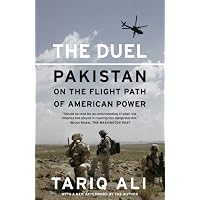
The Duel: Pakistan on the Flight Path of American Power Review

The Duel: Pakistan on the Flight Path of American Power
Average Reviews:

(More customer reviews)
This is an interesting exploration of Pakistan's history and current problems. Tariq Ali, who first gained fame as a leftist student activist in Great Britain in the 1960's, grew up in Pakistan, the son of a leftist editor of one of Pakistan's major newspapers. With his strong connections to the elite in Pakistan he has been able to personally know some of the big shots of the country's oligarchy. He makes use of the insight such connections have given him into the dismal inner workings of Pakistani politics in this book.
He portrays Pakistan as a government controlled by a corrupt bureaucratic-military oligarchy in alliance with feudal landowners and heavily dependent on American backing. The majority of the population lives in horrendous poverty. Communicable diseases and malnutrition are rampant. The Pakistani military and intelligence services greatly assisted the Afghan mujahedeen drug running business in the 1980's. The effects on Pakistan were disastrous. According to Ali, Pakistan had only a few hundred heroin addicts in 1977 but had two million ten years later. But to adopt the view of the Western imperialists--that Pakistan is a cauldron of serious poverty, nuclear weapons and jihadists chomping at the bit--is quite wrong, Ali cautions. Islamic fanatics have terrorized Pakistan since the late 70's when General Zia, with Saudi support, began to provide them with state backing, but they represent a very small segment of Pakistani society. Pakistan has a strong secular tradition and Islamic fundamentalist parties have been never achieved much at the ballot box. Secular parties are even strong in Waziristan, supposedly the main center of jihadist agitation in Pakistan. However what could throw more Pakistanis into alliance with the jihadists, Ali warns, is substantial U.S military operations in Pakistan. US air attacks in Pakistan's western frontier have killed many civilians. If the U.S decides to engage in more substantial military action on Pakistani territory, Ali warns that this might very well throw many Pakistanis into alliance with the jihadists and split the Pakistani army. Segments of the Pakistani army might very well violently resist such aggression by a foreign power, ally with the jihadists and then Pakistan's nukes might find their way into the hands of terrorists.
A large part of the book, and maybe the most interesting part of it deals with the saga of the Bhutto family. Zulfiqar Ali Bhutto created the Pakistan People's Party (PPP) as his personal political vehicle to ride the wave of the popular uprising against the dictatorship of General Ayub Khan in 1968-69. Bhutto had been a minister under Ayub and violently urged on the Pakistani military in its genocidal butcheries in East Pakistan (Bangladesh) in 1971. (The factors leading to Pakistan's mass slaughter and the internal workings and flaws of the Bangladesh independence movement are discussed extensively in this book). Bhutto rode to power promising free health care, free housing, guaranteed food and other socialist rhetoric but he almost completely avoided implementing his promises while in power. He was executed by General Zia on trumped up charges in 1979, after a kangaroo court trial. Ali describes how he got to personally know Bhutto's daughter Benazir in the 1970's and 80's. He expresses some admiration for Benazir's courage in leading resistance against General Zia. But he is unsparing in his account of the gangster character of Benazir's second government (1993-1996). Benazir and her husband Asif Zardari accumulated at least 1.5 billion while she was prime minister and he minister for investment. Courts in England, Spain and Switzerland launched charges against the Bhuttos for receiving tens of millions of dollars in kickbacks from western corporations. Most of the corruption charges against the Bhutto's were dropped as a result of an amnesty for corrupt politicians declared by General Musharraf. Zardari, of course, is now president of Pakistan. Ali also implicates Bhutto and Zardari in the murder of Bhutto's brother. Murtaz Bhutto had been highly critical of the corruption and hollow politics of his sister's regime. In September 1996 the street to Murtaz's house was closed down and dozens of police officers descended upon him and machined gunned him and his bodyguards to death. Meanwhile, Benazir decided to put herself at the disposal of the Bush administration during the crises in Pakistan last year. This fidelity to American imperialism made her a sterling figure in the eyes of the American media and her assassination was mourned as the loss of a great secular democrat and stateswoman, etc. Her stratospheric corruption was forgotten as was her sponsorship of the Taliban in the mid-90's.
Ali also discusses the murder of Daniel Pearl. He argues that several pieces of circumstantial evidence suggest that the Pakistani government may have had some involvement in it. One such piece of evidence is the fact that many Salafi terror groups of the type that claimed credit for Pearl's murder have been the creation and tools of Pakistan's Inter-Services Intelligence (ISI)..........
Ali also discusses the most recent crises in Pakistan, touched off by the firing of Pakistan's chief justice after the latter's investigation of corruption in Musharraf's economic privatization and the "disappearance" of hundreds of dissidents.


Click Here to see more reviews about: The Duel: Pakistan on the Flight Path of American Power


Buy NowGet 39% OFF

Click here for more information about The Duel: Pakistan on the Flight Path of American Power

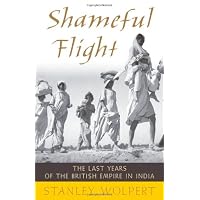
Shameful Flight: The Last Years of the British Empire in India Review

Shameful Flight: The Last Years of the British Empire in India
Average Reviews:

(More customer reviews)
The book is outstanding for many reasons: It is written in an easy style that would force you to read it one go, quite rarely seen in books covering history. Yet the book has sufficient background research that can only be expected from UCLA's professor of history. It has a balanced presentation of facts by a scholar far removed by geography and time from the events.
Stanley Wolpert provides some interesting insights:
British rule of India is a tale of incompetence:
In 1943, India produced 50 million tons of food grains - enough to feed its population of 400 million. Yet 1.5 million people died of starvation in Bengal that year primarily due to mismanagement.
Bengal's governor Herbert and Viceroy Lord Wavell pleaded for food grains to be sent to Bengal. Britain's war transport minister Baron Frederick James Leathers kept 6 million tons stored in ships in Indian Ocean unused. Wavell's report to London says "the famine in Bengal was largely due to ministerial incompetence".
The incompetence was acknowledged in London as well. Churchill's Secretary of State for India Leopold Amery confesses in a private letter to the Viceroy Linlithgow "nothing has convinced me more than the Cabinet meetings.... of the fundamental incapacity of a British cabinet to try and govern India".
Viceroy Wavell condemns Churchill four years later after sitting in one cabinet meeting: "He hates India and everything to do with it. Winston knows as much of the Indian problem as George III did of the American colonies!"British rule of India is a tale of political insensitivity.
The best example of this insensitivity is Winston Churchill's peevish telegram to his Viceroy asking "why Gandhi has not died yet?" after releasing the Mahatma from prison because of medical conditions. Not a class-act in international politics.Partition could have been avoided with greater wisdom in Indian/British leadership.
In 1937 provincial elections the Congress won clear majority in six of the eleven provinces. Jinnah's Muslim league failed to win a single province. Jinnah appealed to Nehru to agree to coalition ministries in the multicultural provinces. Nehru refused and retorted that there were only two parties left: "the British and the Congress". Jinnah devoted the next ten years to create Pakistan. If Nehru had pursued an "inclusive style of politics" there would have been no opportunity to "divide and rule".
1946 offered another opportunity to unite. British Secretary of State, Lord Pethick Lawrence advocated a coalition cabinet (made up of Congress and Muslim League) that decides by consensus and not by majority vote. Nehru declined to cede parity to Muslim league and share power. Maulana Abul Kalam Azad sadly reflected in his autobiography that "Jawaharlal's mistake in 1937 had been bad enough. The mistake of 1946 proved even more costly". This resolved Jinnah to insist on partition.
Britain played the "divide and rule" card to the long term detriment of India. Viceroys were quick to ignore good examples. Chief Ministers Sikandar Hayat Khan and Fazl-i-Husain governed Punjab province by using local patriotism and common language to unify the multi-religious constituency. It was the same Punjab that recorded the largest death triggered by inept governing.British rule had no strategy to deal with partition.
Britain, as a colonial ruler, has a history of shameful behaviour. In 1942, when Britain exited Burma "the civil administration suddenly collapsed and those in charge sought their own safety. Private motor cars were commandeered for the evacuation of Europeans, leaving their owners stranded. .... The city of Rangoon was left at the mercy of .... hardened criminals". There was no thought for life after British rule.
Months ahead of Indian independence British staff were evacuated to Britain leaving no credible law enforcement mechanism for the infant governments of India and Pakistan to deal with the migration induced violence and death.
Mountbatten was aware of the likely violence and the lack of a plan to deal with this. Though Cyril Radcliffe's maps with the boundary lines of India and Pakistan were ready earlier, Mountbatten kept it under lock and key until the pageantry, splendor and photo opportunities of Indpendence day and the British could no more be blamed for the violence or the ineptitude with which it was handled. His reasoning: "the earlier it was published, the more the British would have to bear the responsibility for the disturbances which would undoubtedly result". Reasonable opportunity to manage the migration was denied for the sake of glory.
Says Bengal Secretary John Dawson Tyson, "Mountbatten's focus was on withdrawal in fairly peaceful conditions..... the India after 15 August will not be the kind of country I should want to live in"
Rear Admiral Viscount Lord Louis Francis Albert Victor Mountbatten expressed what he thought about the way he had done his job in India to BBC's John Osmon in 1965. Thirty nine years later Osman says that though he dislikes using vulgar slang, the only honest way of reporting accurately what the last Viceroy said was "I fu....d it up".
Stanley Wolpert concludes that both India and Pakistan are still saddled with the bitter legacies of Great Britain's hasty, shameful flight.
Excellent book.


Click Here to see more reviews about: Shameful Flight: The Last Years of the British Empire in India


Buy NowGet 26% OFF

Click here for more information about Shameful Flight: The Last Years of the British Empire in India